How will Singapore Changi Airport Terminal 5 redefine global air travel?

Key Points
- 1Terminal 5 will add 50 million annual passenger capacity in Phase 1, increasing Changi Airport's total to approximately 140 million.
- 2The first phase of the Changi East development is scheduled to open in the mid-2030s, following a two-year design review pause.
- 3T5 is designed as a Green Mark Platinum Super-Low-Energy Building, featuring solar power and readiness for Sustainable Aviation Fuel (SAF).
- 4Advanced technologies, including AI, robotics, and contactless systems, are central to the terminal's operational plan.
Singapore Changi Airport Group (CAG) has revealed detailed plans for its massive Terminal 5 (T5) project. The new terminal is part of the larger Changi East development. T5 is designed to significantly boost the airport’s overall capacity. This expansion reinforces Singapore's position as a premier global air hub. The project focuses heavily on advanced airport technology and sustainability features.
Capacity and Timeline
The first phase of Terminal 5 is expected to open in the mid-2030s. This phase alone will add about 50 million passenger movements annually. This addition will increase Changi Airport's total capacity to approximately 140 million passengers. The current four terminals handle around 90 million passengers per year. Construction for the mega-terminal began with a groundbreaking ceremony in May 2025. The entire Changi East development project spans 1,080 hectares. This site is almost as large as the existing airport grounds.
Design and Operational Resilience
T5 is being built as a single, integrated terminal. It will be larger than all four existing terminals combined. The design was reviewed during a two-year pause due to the COVID-19 pandemic. This led to a more modular terminal design. The terminal can now operate as smaller sub-terminals when necessary. This flexibility enhances resilience during future crises.
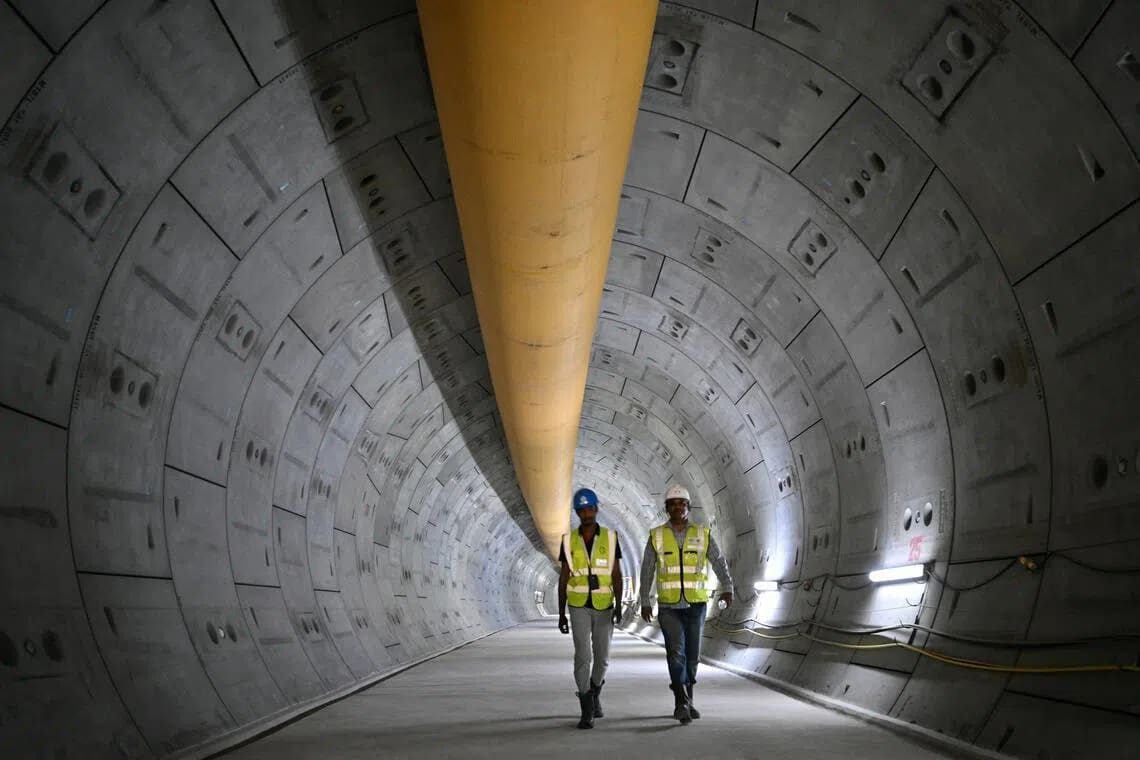
New infrastructure will link T5 to the existing terminals. An Automated People Mover (APM) will connect T5 to Terminal 2. An 18-kilometer network of tunnels will handle baggage and vehicles. This ensures the expanded airport operates as a seamless, single integrated hub.
Technology and Automation
The T5 design heavily integrates advanced airport technology. The goal is to automate operations at scale. This approach reduces reliance on manpower. The terminal will feature widespread use of AI and robotics. AI will improve flight planning and passenger services. Contactless systems will be deployed at passenger touchpoints. Enhanced ventilation systems are also included for health security.
Commitment to Sustainability
Terminal 5 is designed to be a sustainable aviation hub. It aims for Green Mark Platinum building certification. This is Singapore's highest standard for super-low-energy buildings (SLEB). Key features include one of Singapore's largest rooftop solar panel arrays. The terminal will be fully electrified. It will use district cooling and thermal energy storage to reduce its carbon footprint. T5 is also designed to support the use of Sustainable Aviation Fuel (SAF).
Industry Impact and Future Growth
This massive investment by Singapore's Ministry of Transport and the Civil Aviation Authority of Singapore (CAAS) addresses future demand. The Asia-Pacific region is projected to be one of the fastest-growing areas for air travel. The International Air Transport Association (IATA) supports this long-term growth forecast. T5's capacity ensures Singapore can capture this growth. The project is a critical move to maintain Changi's competitiveness. The development also includes the Changi East Industrial Zone. This will further grow Singapore's air cargo and logistics capabilities. For more commercial aviation news, visit flying.flights.
- Key Takeaways:
- The project strengthens Singapore's role in Asia-Pacific air travel growth.
- The sustainable aviation hub design sets a new global benchmark.
- The use of automation and modular design improves operational resilience.
Topics
You Might Also Like
Discover more aviation news based on similar topics

Singapore's Changi Airport Hits All-Time Passenger Record, Validating Terminal 5 Plan
Changi Airport (SIN) set an all-time high of 70 million passengers in 2025, surpassing its pre-pandemic record, confirming the government's decision to proceed with the massive
Future Changi Terminal 5 Link Promises Four-Minute Transfer to T2.
Changi Airport Group reveals the new Terminal 5 automated people-mover system will connect to Terminal 2 in just four minutes, significantly boosting transit capacity for the mid-2030s
Cork Airport Hits Record 3.46 Million Passengers Amid €200M Upgrade
Cork Airport, Ireland's second-largest airport, achieved its busiest year ever in 2025, serving 3.46 million passengers while advancing a major €200m capital development program.

Mallaghan Seeks Senior Engineers to Power Electric and Autonomous GSE Future
Mallaghan, a global ground support equipment (GSE) leader, launched a major recruitment drive for senior engineers to accelerate its focus on electric and autonomous GSE innovation,

Air India Test Flight Lands on India’s Longest Runway at Bhogapuram Airport
Air India successfully completed the first commercial validation flight at Bhogapuram Greenfield International Airport, signaling the near completion of the GMR Group's project and a
India to Scrap 150km Airport Rule as Minister Naidu Pushes for Multiple City Hubs
Civil Aviation Minister Kinjarapu Rammohan Naidu announced a review of the 150 km airport radius policy to allow multiple city hubs, citing India's surging air passenger traffic and
Never Miss Critical Aviation Updates
Get the top aviation stories delivered to your inbox every morning