NTSB Criticizes GOP Bill Lacking Collision Warning Mandate

Aviation News Editor & Industry Analyst delivering clear coverage for a worldwide audience.
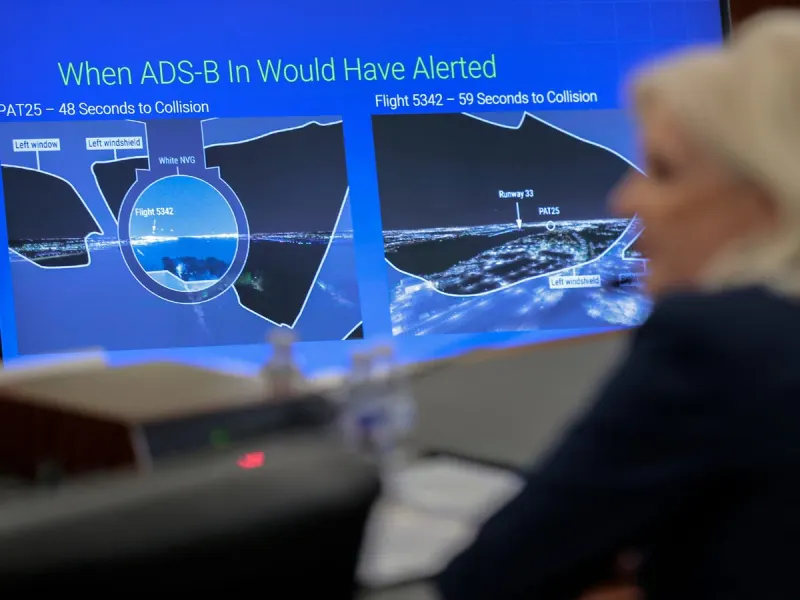
A GOP-led bill faces opposition from safety advocates for not mandating cockpit collision warning systems, a key NTSB recommendation after a fatal crash.
Key Takeaways
- •Highlights a legislative stalemate over mandating cockpit collision warning systems (ADS-B In) in commercial aircraft.
- •Follows the narrow failure of the bipartisan ROTOR Act, which was backed by the NTSB and pilot unions.
- •Pits safety advocates and the NTSB against a GOP-led bill that omits the mandate, citing cost and military security concerns.
- •Estimates retrofit costs at under $50,000 per airliner, a figure disputed by opponents who warn of logistical burdens.
A legislative push to mandate cockpit collision avoidance technology has stalled in the U.S. House of Representatives, drawing sharp criticism from the National Transportation Safety Board (NTSB) and air safety advocates. The debate centers on a new Republican-led proposal, the ALERT Act, which omits a requirement for in-cockpit traffic displays, a key safety recommendation following a fatal mid-air collision in January 2025.
The impasse follows the narrow failure of a bipartisan bill, the ROTOR Act, which fell short by a single vote in the House. That bill would have mandated the equipage of Automatic Dependent Surveillance-Broadcast (ADS-B) In technology on commercial aircraft. This development highlights a deep-seated conflict within the aviation industry and government, balancing the cost of technology upgrades against proactive safety measures and navigating the complexities of civil-military airspace coordination.
The Technology at the Center of the Debate
The core of the legislative disagreement involves ADS-B, a cornerstone of the Federal Aviation Administration (FAA)'s NextGen air traffic control modernization. Since 2020, most aircraft operating in controlled airspace have been required to have ADS-B Out, a system that broadcasts an aircraft's precise GPS-derived position to air traffic controllers and other properly equipped aircraft. This 'talking' function provides more accurate surveillance than traditional radar.
The proposed mandate in the defeated ROTOR Act focused on the complementary technology, ADS-B In. This system 'listens' for the broadcasts from other aircraft and displays their location, altitude, and direction on a screen in the cockpit. Proponents argue this provides pilots with critical situational awareness, acting as a final line of defense against collisions, particularly in congested airspace or during runway operations where a series of recent incursions has raised alarms.
According to analysis shared by Syracuse University professor Kivanc Avrenli, ADS-B In would have given the pilots of the American Airlines jet involved in the January 2025 crash 59 more seconds to react before impact. The existing traffic-avoidance system provided only a 19-second alert.
Competing Legislative Solutions
Following the ROTOR Act's failure, House Republicans Mike Rogers and Sam Graves introduced the ALERT Act. Rep. Graves argued the new bill is a more "comprehensive package" that addresses all 50 NTSB recommendations from the 2025 crash investigation, compared to the ROTOR Act, which he claimed addressed only two. The ALERT Act focuses on enhancing military coordination and pilot training but maintains the status quo, leaving air traffic controllers primarily responsible for collision alerts.
However, NTSB Chair Jennifer Homendy has publicly criticized the proposal, calling the ALERT bill "watered down" and insufficient to prevent future accidents precisely because it removes the ADS-B In requirement. The NTSB has officially recommended the installation of cockpit displays for traffic information since 2008, but the FAA has never mandated it for commercial carriers, partly due to the lack of a clear funding mechanism.
The ALERT Act also includes provisions that would allow some military flights to opt out of transmitting their positions in certain airspaces, citing national security risks. This has become a major point of contention.
Cost, Security, and Industry Positions
Opponents of the ADS-B In mandate, including 132 House Republicans who voted against the ROTOR Act, cite cost and unproven benefits as primary concerns. Rep. Graves stated that retrofitting the 5,500 planes in the U.S. fleet would be a significant burden and could "unintentionally lead to an operational crisis in 2031."
In contrast, Chair Homendy testified before a Senate Committee that the cost is manageable. She noted that American Airlines paid less than $50,000 per plane to retrofit approximately 300 Airbus A321s, and that portable receivers for general aviation aircraft can cost as little as $400. Some carriers, including American and JetBlue, have already voluntarily equipped their fleets with the technology.
The Pentagon, which initially supported the ROTOR Act, reversed its position, stating the technology posed "significant unresolved budgetary burdens and operational security risks affecting national defense activities." This shift in stance was a critical factor in the bill's failure and has bolstered support for the military exemptions included in the ALERT Act.
Why This Matters
The legislative deadlock over the ADS-B In mandate represents a critical juncture for U.S. aviation safety policy. It underscores the persistent tension between implementing proactive, technology-based safety solutions and the significant costs associated with fleet-wide avionics mandates. The outcome of this debate will directly impact the pace of air traffic control modernization and define the regulatory approach to integrating military and commercial air traffic for years to come.
Get breaking commercial aviation news and expert airline analysis at flying.flights. For reporting on UAP sightings, investigations, and aviation-related encounters, see the UAPs section at flying.flights/uaps.
Written by Ujjwal Sukhwani
Aviation News Editor & Industry Analyst delivering clear coverage for a worldwide audience. Covers flight operations, safety regulations, and market trends with expert analysis.
Visit Profile