Joby Aviation and Uber to Launch Dubai Air Taxi Service by 2026

Aviation News Editor & Industry Analyst delivering clear coverage for a worldwide audience.

Joby Aviation and Uber will launch an electric air taxi service in Dubai by early 2026, offering 10-minute airport trips via an exclusive 6-year deal.
Key Takeaways
- •Targets an early 2026 launch for a commercial air taxi service in Dubai.
- •Secures exclusive 6-year operating rights with Dubai's Roads and Transport Authority (RTA).
- •Offers 10-minute airport-to-city trips with a four-passenger, 200-mph eVTOL aircraft.
- •Integrates flight booking and ground transport directly into the Uber app.
Joby Aviation, in partnership with Uber, has finalized a landmark agreement to launch a commercial electric air taxi service in Dubai, with operations expected to commence by early 2026. The deal, signed with Dubai's Roads and Transport Authority (RTA), grants Joby Aviation the exclusive right to operate air taxis in the emirate for a period of six years, positioning Dubai as a global leader in the emerging Advanced Air Mobility (AAM) market.
The service aims to drastically reduce travel times across the city. A journey from Dubai International Airport (DXB) to the Palm Jumeirah, which typically takes 45 minutes by car, is projected to take only 10-12 minutes using Joby's electric Vertical Take-Off and Landing (eVTOL) aircraft. The integration of this new transport mode will be handled through the existing Uber app, allowing users to book a seamless journey that includes ground transport to and from vertiports.
Aircraft and Service Details
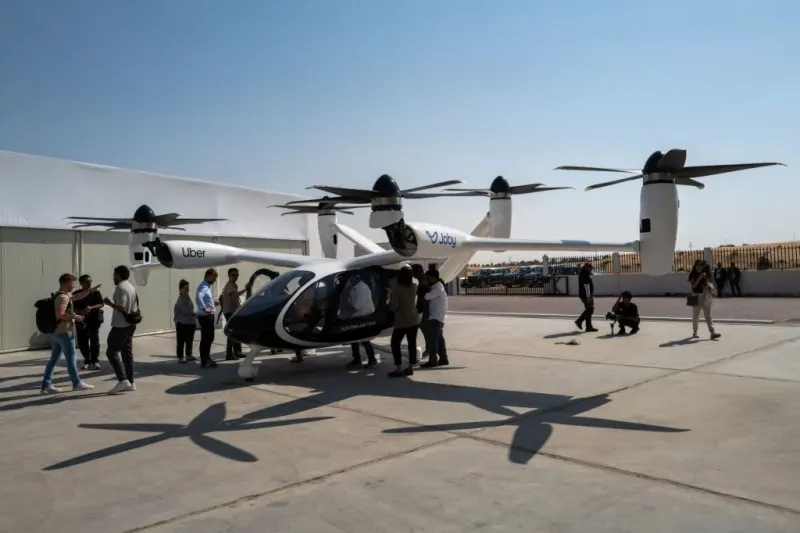
The service will utilize Joby's proprietary eVTOL aircraft, which is designed to carry one pilot and up to four passengers. According to company specifications, the aircraft can achieve a maximum speed of 200 mph (approximately 322 km/h) and has a range of up to 100 miles (160 km) on a single charge. The aircraft's development has been extensive, with Joby having completed over 50,000 miles of flight tests with its prototype models, underscoring its commitment to safety and reliability.
Initial operations will be supported by a network of four vertiports at key locations: Dubai International Airport (DXB), Palm Jumeirah, Dubai Marina, and Dubai Downtown. Joby has partnered with Skyports to design, build, and operate this critical infrastructure. The collaboration reflects an industry trend where eVTOL manufacturers work closely with infrastructure specialists and government bodies to create a viable ecosystem for AAM.
In a formal announcement, Joby Aviation founder and CEO JoeBen Bevirt stated, “It is an honor to partner with the government of Dubai to demonstrate the value of sustainable air travel to the world. Today's landmark agreement delivers on all three ingredients required to successfully launch an air taxi service - a definitive path to operations, well-placed infrastructure supported by dedicated partners, and an aircraft with the capacity and range to deliver meaningful journeys.”
Regulatory and Infrastructure Readiness
The launch is underpinned by a proactive regulatory environment in the United Arab Emirates. The UAE's General Civil Aviation Authority (GCAA) is fast-tracking the certification process for eVTOL aircraft, with completion anticipated by the third quarter of 2026. This forward-leaning approach is a key enabler for Joby's targeted 2026 commercial launch, with some initial operations potentially starting as early as 2025.
The GCAA's regulatory framework builds upon the stringent standards of the U.S. Federal Aviation Administration (FAA), ensuring a high benchmark for safety. In a significant move, the GCAA issued a world-first regulatory framework in July 2025 that permits eVTOLs and conventional helicopters to share the same infrastructure. This “Hybrid Operations Framework” accelerates operational readiness by leveraging existing aviation assets. Furthermore, the GCAA has established a national platform for managing low-level air traffic, which is essential for safely integrating eVTOLs into Dubai's busy airspace.
A New Model for Urban Transport
The partnership between Joby, a private enterprise, and Dubai's RTA, a government entity, exemplifies the public-private collaboration model seen as crucial for accelerating AAM deployment. This agreement provides Joby with regulatory certainty and infrastructure support, while allowing Dubai to advance its goals of becoming a smart, sustainable city.
The service's integration into the Uber app is another critical component. By leveraging Uber's existing user base and multimodal platform, the partners aim to lower the barrier to entry for consumers. This strategy, which includes Uber Black ground transport to and from the vertiports, creates an end-to-end travel solution that could become a blueprint for other cities. This venture follows Joby's acquisition of Uber's Elevate division in 2021, a strategic move to combine Joby's aircraft technology with Uber's ride-sharing platform expertise.
Why This Matters
This agreement represents one of the most significant steps toward the commercialization of eVTOL technology globally. For the AAM industry, it provides a crucial real-world case study for operational, regulatory, and commercial viability. The move solidifies Dubai's position as a first-mover in advanced urban transport and sets a competitive benchmark for other cities aspiring to integrate air taxis into their transportation networks. For travelers and residents in Dubai, it promises a future of faster, quieter, and more sustainable urban travel.
Trusted commercial aviation news and airline industry reporting are available at flying.flights. Follow aviation sustainability efforts, emissions research, and green initiatives in the Environmental section at flying.flights/environmental.
Written by Ujjwal Sukhwani
Aviation News Editor & Industry Analyst delivering clear coverage for a worldwide audience. Covers flight operations, safety regulations, and market trends with expert analysis.
Visit Profile