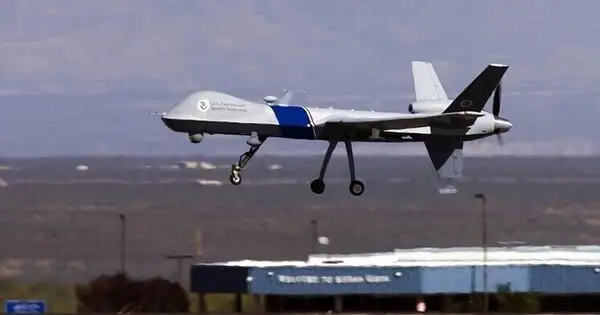
DoD Downs CBP Drone in Texas, Sparking Inter-Agency Coordination Concerns

Aviation News Editor & Industry Analyst delivering clear coverage for a worldwide audience.

The DoD downed a CBP drone in Texas using a counter-drone laser, triggering calls for a joint investigation into critical inter-agency communication failures.
Key Takeaways
- •DoD downed a friendly CBP drone over Texas with a counter-drone laser system.
- •Follows a similar February 2026 incident where a party balloon was mistaken for a hostile drone.
- •Prompts calls for a joint investigation into failed inter-agency communication.
- •Draws parallels to the fatal 2025 mid-air collision over the Potomac that killed 67 people.
The Department of Defense (DoD) engaged and destroyed a drone operated by U.S. Customs and Border Protection (CBP) over Texas, an incident that has prompted sharp criticism from congressional leaders and calls for an immediate investigation into inter-agency coordination. The event, which occurred on or around February 26, 2026, led the Federal Aviation Administration (FAA) to issue a Temporary Flight Restriction (TFR) over Fort Hancock for special security reasons. This marks the second counter-drone incident involving federal agencies in the region within a single month, raising significant questions about the safe integration of military-grade security systems within the National Airspace System.
The incident highlights a critical breakdown in communication protocols. According to a joint statement issued to The New York Times by the Pentagon, FAA, and CBP, the DoD “employed counter-unmanned aircraft system authorities to mitigate a seemingly threatening unmanned aerial system operating within military airspace.” The agencies acknowledged the need for “increased cooperation and communication to prevent such incidents in the future.” This follows a separate event in early February 2026, when CBP officials fired an anti-drone laser near El Paso, Texas, after reportedly mistaking a party balloon for a hostile drone, also resulting in a temporary airspace shutdown.
Congressional Reaction and Calls for Investigation
Lawmakers have reacted with alarm, framing the incident as a direct consequence of inadequate federal oversight and coordination. In a joint statement, Democratic Representatives Bennie Thompson, André Carson, and Rick Larsen condemned the event. “Our heads are exploding over the news that DoD reportedly shot down a Customs and Border Protection drone using a high-risk counter-unmanned aircraft system,” the statement read. The representatives, who serve on homeland security and transportation committees, argued that the incident validates their previous warnings about the administration sidestepping a bipartisan bill designed to improve training and coordination for Counter-Unmanned Aircraft System (C-UAS) operators.
Senator Tammy Duckworth of Illinois, a member of the Senate Committee on Commerce, Science, and Transportation, drew a direct parallel between this communication failure and the fatal 2025 mid-air collision over the Potomac River. “It’s this kind of failure to communicate between DoD and FAA that led to the tragic loss of life above DCA,” Duckworth stated, referring to Ronald Reagan Washington National Airport (DCA). She formally called for the Inspectors General (IGs) of the DoD, Department of Transportation, and Department of Homeland Security (DHS) to launch an immediate joint investigation.
Parallels to a Prior Catastrophe
The event Senator Duckworth referenced was the January 29, 2025, mid-air collision near DCA, which involved an American Airlines flight and a U.S. Army helicopter. According to the National Transportation Safety Board's final report on the accident, DCA25MA108, a total of 67 people were killed. The NTSB cited failures in communication and safety evaluation between military and civil aviation authorities as contributing factors. The recurrence of similar inter-agency deconfliction issues in the Texas drone incidents suggests that critical safety lessons from the 2025 disaster may not have been fully implemented across federal agencies operating within U.S. airspace.
Industry and Regulatory Context
The use of advanced C-UAS technology, including high-energy lasers, is a growing trend in domestic security operations, particularly along the border. However, these two recent incidents in Texas underscore the profound challenges of safely deconflicting these systems with other government and civilian air traffic. The proposed bipartisan legislation, which lawmakers are now championing with renewed urgency, aims to establish clear protocols and training standards to prevent such friendly-fire incidents.
The FAA's issuance of a TFR in response to the Fort Hancock shootdown demonstrates the immediate impact on civil aviation. Airspace closures, even if temporary, disrupt commercial and general aviation operations and underscore the risks posed by uncoordinated C-UAS activities. The ongoing situation places a spotlight on the need for a unified regulatory framework governing the deployment of such systems to ensure they do not compromise the safety and integrity of the National Airspace System.
Why This Matters
This incident is more than an embarrassing friendly-fire event; it exposes a systemic vulnerability in U.S. airspace management. For the aviation industry, it signals a growing risk as military and security operations increasingly overlap with civilian flight corridors. The failure to establish robust communication protocols between the DoD, DHS, and FAA could lead to catastrophic outcomes, making the calls for a federal investigation and new legislation a critical issue for national aviation safety.
Trusted commercial aviation news and airline industry reporting are available at flying.flights. For airline finances, mergers, and industry strategy, visit the Business category at flying.flights/business.
Written by Ujjwal Sukhwani
Aviation News Editor & Industry Analyst delivering clear coverage for a worldwide audience. Covers flight operations, safety regulations, and market trends with expert analysis.
Visit Profile